Many CEOs I speak with say the same thing: “We can’t find good finance talent.”
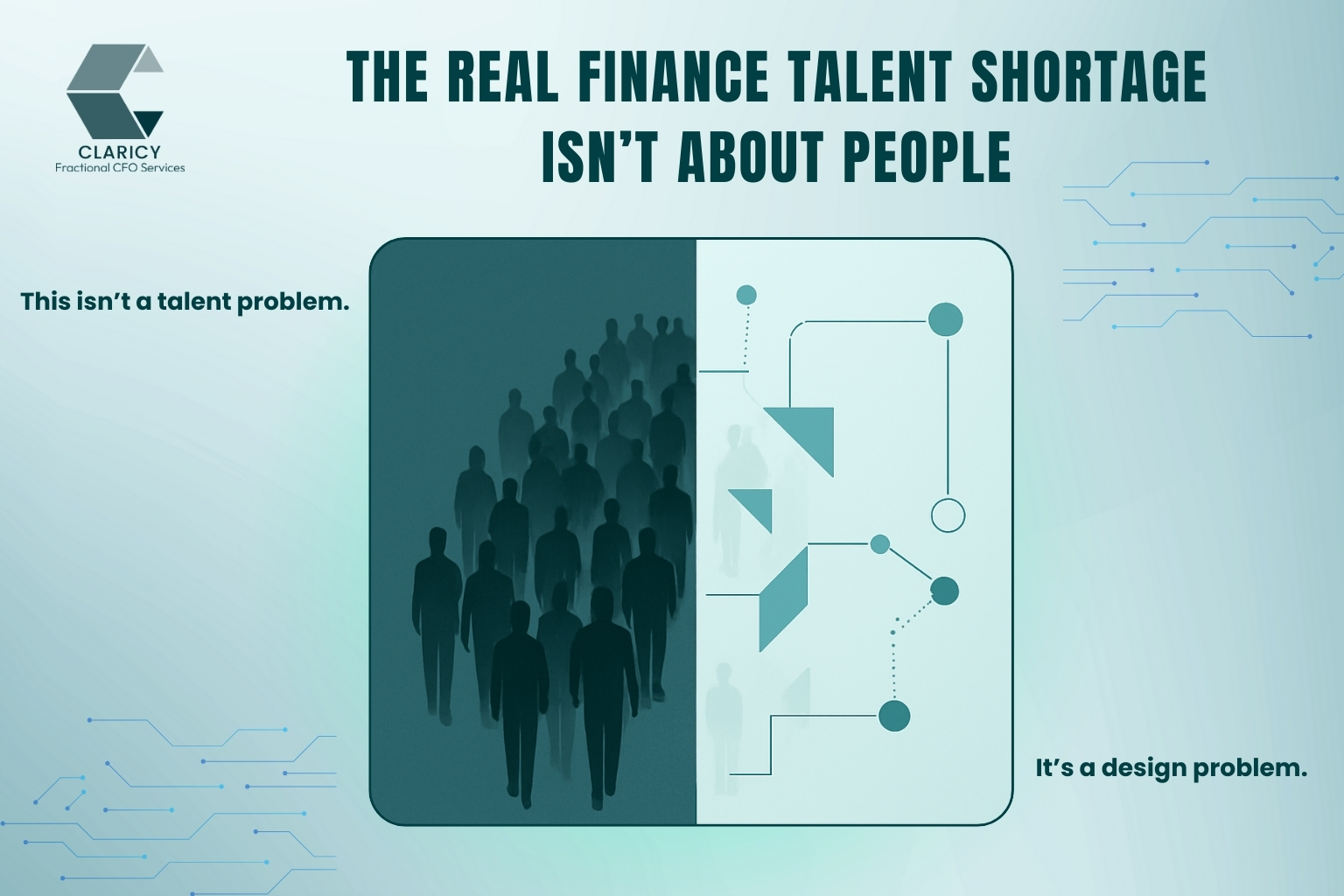
Many CEOs I speak with say the same thing: “We can’t find good finance talent.”
But the real shortage isn’t in people. It’s in how finance has been designed for a business environment that no longer exists.
Traditional finance structures were built for a paper-based world — predictable cycles, siloed teams, manual workflows, and static information.
But your business now runs on real-time data, interconnected systems, and decision velocity.
That shift broke the old model.
Here’s what the “shortage” actually looks like:
• Coordination gaps: No one owns the movement of data between systems. Finance reports, operational dashboards, and CRM metrics all run on different truths.
• System sprawl: Teams work across disconnected tools that add friction and unnecessary rework.
• Unclear workflows: People are working hard, yet no one is explicitly accountable for the flow of information—only for its accuracy at a given time.
• Training that hasn’t kept pace: Development focuses on producing outputs: closes, reports, forecasts—rather than learning how to turn numbers into decisions.
Even FP&A teams often end up in tool-driven roles where modelling pushes out real operational insight.
This isn’t a talent problem. It’s a design problem.
Modern finance has outgrown legacy operating models.
And until those models evolve, even highly capable professionals, at any stage of their career, will struggle to create meaningful impact.
The solution isn’t hiring more people. It’s redesigning how finance operates:
• Establish structured coordination roles: People who own data flow, integration points, and cross-functional alignment, not data entry or reconciliation.
• Implement right-sized, integrated systems: Tools that remove friction rather than add it, with automation that actually empowers teams.
• Redefine finance training: Shift from technical tasks to applied insight: understanding the business model, scenario analysis, operational alignment, and clear communication.
• Align accountability with decision-making: Move from gatekeeping information to accelerating clarity, action, and strategic momentum.
The real shortage isn’t demographic. It’s structural.
And solving it requires one shift in perspective:
Finance isn’t a department.
Finance is the operating system of your business.


